
How to Be Proficient in the
CPCAB Level 2 Assessment Record

Studying for your CPCAB Level 2 is an incredibly rewarding journey, but the assessment process can feel overwhelming. Many students get caught in “criteria confusion,” struggling to translate what happens in the classroom into being proficient with the criteria.
Because the CPCAB completely removed the external exam, your entire assessment now rests on your internal assessment. Your training centre is fully responsible for your work, making the standards for your CPCAB Level 2 assessment record higher than ever.
Here is your practical, step-by-step guide to completing your CPCAB Level 2 assessment record with confidence.
How Your CPCAB Level 2 Assessment Record is Assessed (The “Rule of Two”)
To be marked as proficient, you cannot just write a single essay and call it a day.
The CPCAB requires you to provide two distinct pieces of evidence for each of the 23 criteria elements.
To do this, your evidence must be across three different assessment methods:
Written reflections: Your weekly reflective learning reviews, self-reviews, and written assignments.
Tutor Observation: Signed-off feedback from your tutor watching you practice your counselling skills in class.
Peer feedback: Written feedback from your peers based on your skills practice.
Tutor Tip: Jay’s Portfolio Hack…
“Keep a digital tracker of the 23 criteria from day one. Every time your tutor gives you a positive observation sheet or a peer writes you a feedback form, highlight which criteria they mentioned and file it immediately. Don’t leave your portfolio mapping until the final week of the course!”
Mastering the Weekly Learning Review (The “Reflection vs. Description” Trap)
The single biggest reason students have their work sent back for re-submission is that they write descriptive rather than reflective journals.
Tutors do not want to read a diary entry of what happened in class. They want to see how the class affected you.

❌ A Descriptive Entry:
“This week we practised empathy. I sat with Sarah, and she told me about her stressful week at work. I listened to her and nodded my head to show I was paying attention.”
✅ A Reflective Entry:
“While practising empathy with Sarah, I noticed myself wanting to jump in and offer advice when she spoke about her stressful job. By identifying this internal urge, I was able to consciously set it aside (Criteria 4.2) and remain focused on her perspective. This taught me that my personal history of ‘fixing’ problems can sometimes block my ability to offer pure empathy (Criteria 3.1, 5.2).”
The “What, So What, Now What” Journal Structure
If you struggle with reflective writing, use this simple three-step structure for your weekly 300 to 400-word learning reviews:
1. What? Briefly state the factual event or skill practised. Keep it to one or two sentences.
2. So What? What did you feel? What internal thoughts arose? Which of your personal values or past experiences were triggered by this? Connect this directly to a CPCAB criterion (e.g., “This links to Criterion 3.3 because…”).
3. Now What? What did you learn about yourself as a helper, and how will you apply this learning in your next practice session?
How to Ace Your Skills Triads (Helper, Helpee, Observer)
Okay, so how do residential counselling courses compare to standard?
Here, we explore the pros and cons of both a residential course and a standard course, to help you decide which might be right for you!
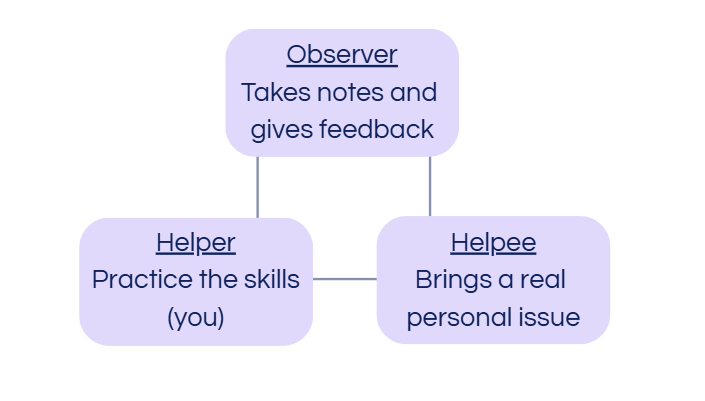
To get the best portfolio evidence out of these sessions, follow these role-specific guidelines:
As the Helper (You Practising)
- Don’t try to be perfect: Tutors don’t expect flawless counselling at Level 2. In fact, making a mistake (like accidentally giving advice), noticing it, and correcting yourself in your journal makes for much better reflective evidence.
- Focus on the core skills: Keep your questions open, paraphrase regularly, and don’t be afraid of silence.
As the Helpee (Your Peer)
- Bring real, low-stakes issues: Do not make up a fake scenario – it makes it very difficult for the helper to practice authentic empathy. Bring real, mild everyday stresses (e.g. minor work stress, deciding on a holiday, a habit you want to break). Do not bring deep trauma, as Level 2 environments are not designed to hold clinical crises.
As the Observer
- Write down exact quotes: Don’t just tell the helper “You were great.” Write down exactly what they said: “At minute 4, you used a brilliant paraphrase when you said…” This gives them concrete evidence to quote in their written reflections.
The Path to Progression: Why Your Portfolio Quality Matters
Because there is no longer a CPCAB exam, your Level 2 tutor will decide if you are proficient and ready to progress to Level 3 (Certificate in Counselling Studies).
When looking at your CPCAB Level 2 assessment record, they aren’t just checking if you ticked the boxes – they are looking to see if you have developed the emotional maturity and self-awareness required to move on to deeper therapeutic studies.
Checklist for a proficient CPCAB Level 2 assessment record:
1. Track Criteria Weekly: Don’t wait until the end of the term to map your 23 criteria.
2. Be Reflective, Not Descriptive: Focus on your feelings, reactions, and learnings in your journals.
3. Be Honest About Mistakes: Your tutor wants to see self-awareness, not perfection.
4. Collect Peer Feedback Early: Make sure your triad partners are writing down specific, constructive feedback for you every week.
Struggling with the Theory? Get Free Access to Our Video Library
We know that a 3-hour weekly lecture can go by in a flash, leaving you to grapple with complex concepts and criteria mapping all on your own.
That is why we’ve made our entire Level 2 digital video library available to students training at any UK-based tuition provider – completely free of charge.
This structured learning pathway breaks down the exact theory your tutors are grading you on into clear, bite-sized visual modules. Plus, you get personal access to the Astranti mentoring team to guide you along the way!

Want to talk to someone about your
next course options?
If you have any questions about Astranti Connect’s counselling courses , you can have a free 1-2-1 call with one of our Connect student advisors!
Head to your relevant course page below to book yours:
Comments
Illustration by Storyset.